PDF Ebook Who Fears Death, by Nnedi Okorafor
And also why this publication ends up being so preferred is that the presented book originates from the preferred writer worldwide. Many individuals admire the literary works about every little thing. The topic to discus and offer is also much related to the day-to-day live. So, you can be part of their mind and also thought that consider this incredible publication. To stimulate what is informed by Who Fears Death, By Nnedi Okorafor, you can start to read it currently.
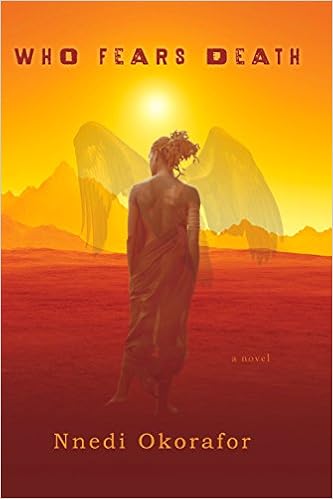
Who Fears Death, by Nnedi Okorafor

PDF Ebook Who Fears Death, by Nnedi Okorafor
Schedule Who Fears Death, By Nnedi Okorafor is among the precious worth that will make you always rich. It will certainly not mean as rich as the cash give you. When some people have lack to encounter the life, people with many publications often will certainly be smarter in doing the life. Why should be publication Who Fears Death, By Nnedi Okorafor It is in fact not suggested that publication Who Fears Death, By Nnedi Okorafor will certainly offer you power to get to everything. The book is to read and also exactly what we implied is guide that is reviewed. You can likewise view exactly how the publication qualifies Who Fears Death, By Nnedi Okorafor and also numbers of publication collections are supplying below.
But, after discovering this site you could not be question and also really feel hard anymore. It appears that this site offers the very best collections of guide to review. When you want such topic, Who Fears Death, By Nnedi Okorafor can be an option. Wow, like this publication a lot. Do you feel the very same? Well, really, it's not mosting likely to be hard when anticipating this publication as the analysis product. After discovering the great internet site as this online collection, we will certainly be so very easy in discovering several genres of publications.
By visiting this page, you have actually done the appropriate looking point. This is your begin to select guide Who Fears Death, By Nnedi Okorafor that you desire. There are lots of referred books to check out. When you would like to obtain this Who Fears Death, By Nnedi Okorafor as your publication reading, you could click the web link page to download Who Fears Death, By Nnedi Okorafor In few time, you have actually owned your referred books as yours.
knowing more about this book, you can disclose exactly how this book is vital for you to check out. This is one of the reasons why you need to read it. However, the presented Who Fears Death, By Nnedi Okorafor can be suggested to conquer the issues that you encounter currently, most likely. Also you have the best selection, getting details and also factors to consider from a few other sources are requirement. You could have a lot more times to know about the issues and the best ways to solve it. When you need entertainment making enjoyable, you could get some from this publication.
Amazon.com Review
An Origin Story Nnedi Okorafor is a writer of Nigerian descent known for weaving African culture into creative evocative settings and memorable characters. She is know for her young adult novels, including The Shadow Speaker and Zahrah the Windseeker. “My life fell apart when I was sixteen. Papa died.†Those are the opening lines of Who Fears Death. I remember when I wrote them. I was thinking of Chinua Achebe’s Things Fall Apart. I was thinking of change, cultural shift, chaos. Okonkwo’s death. And my own father’s very recent death. Yeah, all that in those two lines. In more ways than one, the opening scene of Who Fears Death, titled “My Father’s Faceâ€, was the beginning of it all. Originally, it was not the beginning of the novel. This scene takes place well into the story when my main character Onyesonwu is sixteen and has been through so much. The original beginning was when Onyesonwu was five years old and happy, living with her mother in the desert. Nevertheless, “My Father’s Face†was the first scene I wrote. Though my stories tend to be mostly linear, I’m a non-linear writer. I’ll write the middle, then the ending, then the beginning and kind of jump around until I’m done. Then I’ll tie all the scenes together and neaten it up. Nevertheless, when Who Fears Death was all said and done, I wasn’t surprised that “My Father’s Face†turned out to be the beginning of the actual book. I started writing Who Fears Death just after my father passed in 2004. I was very very close to my father and writing was my way of staying sane. I based “My Father’s Face†on a moment I experienced at my father’s wake when everyone had cleared out of the room and I found myself alone with his body. I was kneeling there looking at his face, thinking how much it no longer looked like him and how terrible that was. My morbid thoughts were driving me into deeper despair. Then suddenly I felt an energy move though me. This energy felt highly destructive, as if it could bring down the entire building. Almost all the details in the scene I went on to write were true, I felt them…well, up to the part where Onyesonwu makes her father’s body breath. As soon as I wrote that scene, everything else rushed at me. My father’s passing caused me to think about death, fear, the unknown, sacrifice, destiny and cosmic trickery. Only a week or so after my father’s passing, I read the Washington Post article, We Want to Make a Light Baby: Arab Militiamen in Sudan Said to Use Rape as Weapon of Ethnic Cleansing by Emily Wax. I was absolutely infuriated. The storytelling spider in my head started weaving faster. I realized that this article was showing me why the people in my story’s town disliked Onyesonwu and why she was so troubled. My mother, my sister Ifeoma and my brother Emezie flew with my father’s body back to Nigeria for his burial. When they returned, I learned through my siblings about the way widows were treated within Igbo custom, even the ones with PhDs…like my mother. I was again infuriated. And I was reminded yet again of why I was a feminist. A year later, I went to Nigeria for the one-year memorial where I met my cousin Chinyere’s fiancé Chidi. His last name was Onyesonwu. I was intrigued. I knew “onye†meant “who†and “onwu†meant death. I wondered if it was an ogbanje name (these named often have the word “death†in them). I’d always been interested in the concept of the ogbanje. Amongst the Igbos, back in the day, girls who were believed to be ogbanjes were often circumcised (a.k.a. genital mutilated) as a way to cure their evil ogbanje tendencies. I asked my cousin’s fiancé what his name meant (I thought it would be rude to ask if it was an ogbanje name. Plus it was his last name, not his first.). He said it meant, “Who fears death.†That night, I changed my character’s name and the title of the story. When I did that, it was as if the novel snapped into focus. During that trip, I touched my father’s grave. I heard stories about the Biafran War and arguments about how what happened during this civil war was indeed the genocide of the Igbo people. I saw death on the highway and thanked the Powers That Be that my daughter (who was some months over one year old) was asleep. I got to watch the women in my father’s village sing all night in remembrance of my father. My maternal grandmother, mother, daughter and I were all in the same room at the same time- four generations. My sister Ngozi and I visited the lagoon that seemed so huge when we were kids but was really quite small. It was populated by hundreds and hundreds of colorful butterflies. I wrote, conceived and incubated parts of Who Fears Death while in my father’s village, sometimes scribbling notes while sitting in the shade on the steps outside or by flashlight when the lights went out. I wrote notes on the plane ride home, too. When I think back to those times, I was in such a strange state of mind. My default demeanor is happy. I think during those times I was as close to sad as I could get. When I got back to the States, I kept right on writing. Who Fears Death was a tidal wave and hurricane combined. It consumed all of my creativity and sucked in all the issues I was dealing with and dwelling on. It mixed with my rage and grief and my natural furious optimism. Yet when it came to writing the story, I was more the recorder than the writer. I never knew what was going to happen until my character told me and my hands typed it. When I finished Who Fears Death, it was seven hundred pages long. A Book 1 and a Book 2. Don Maass (my agent) felt this size was too great and suggested that I pare it down. This process took me another two years. One of my favorite quotes is from one of my greatest idols, Nigeria’s great writer and Nobel Laureate Wole Soyinka: “A tiger does not proclaim its tigritude. It pounces.†This tiger of a story definitely pounced on me without proclamation or warning. I’m glad I was ready for it. --Nnedi Okorafor
Read more
From Publishers Weekly
Starred Review. Well-known for young adult novels (The Shadow Speaks; Zahrah the Windseeker), Okorafor sets this emotionally fraught tale in postapocalyptic Saharan Africa. The young sorceress Onyesonwu—whose name means Who fears death?—was born Ewu, bearing a mixture of her mother's features and those of the man who raped her mother and left her for dead in the desert. As Onyesonwu grows into her powers, it becomes clear that her fate is mingled with the fate of her people, the oppressed Okeke, and that to achieve her destiny, she must die. Okorafor examines a host of evils in her chillingly realistic tale—gender and racial inequality share top billing, along with female genital mutilation and complacency in the face of destructive tradition—and winds these disparate concepts together into a fantastical, magical blend of grand storytelling. (June) Copyright © Reed Business Information, a division of Reed Elsevier Inc. All rights reserved.
Read more
See all Editorial Reviews
Product details
Hardcover: 400 pages
Publisher: DAW; First Edition edition (June 1, 2010)
Language: English
ISBN-10: 075640617X
ISBN-13: 978-0756406172
Product Dimensions:
6.4 x 1.4 x 9.3 inches
Shipping Weight: 1.4 pounds (View shipping rates and policies)
Average Customer Review:
4.5 out of 5 stars
320 customer reviews
Amazon Best Sellers Rank:
#529,746 in Books (See Top 100 in Books)
This book will change the way I see the world forever. It is a genre so different and yet so similar to those I have read before, but it made such an impression on me. I am going to read everything Nnedi Okorafor has ever written, because it will make my world better and deeper. How many books can you say have done that for you? Few for me. I cannot recommend it to you highly enough. Who Fears Death had just enough fantasy, just enough feminism, just enough social justice, and just enough beauty to leave me in awe of every word. Okorafor has won a ton of awards for a reason—I couldn't believe her talent.Onyesonwu is a formidable human being. She is strong and angry. She has power. She is not particularly feminine, and yet also incredibly woman. She is both good and bad, but mostly good. It is hard to wrap your head around her character, but she also finds it hard to wrap her head around her own self, so this isn't surprising. The result is that even though she is magical and powerful, she is also extremely human, and very beautiful.The other characters in the story begin as very two-dimensional, but as it progressed, I found myself surprised by how much I either loved or hated them. This helped reinforce the theme that all people are human, that no one deserves to be treated a specific way based on superficial impressions, and that the world can always use more compassion.If you take only one of my recommendations ever, let it be this one. Read this book.
I want to recommend this book, but I also feel obligated to warn; come to this story with a light heart, because you will be leaving with a heavy one.Who Fears Death. A great title, and the name of our protagonist as well; Onyesonwu. Nnedi Okorafor's powerful story takes place in a future Africa. How far into the future is not made clear, but the setting is very interesting. Computers and GPS systems still linger, and though they are used, no one seems to know exactly how they work. The exact setting is revealed near the end, but I won't mention it here. It feels like something to discover on your own.Onyesonwu is Ewu, a child of violence; born of rape. She is a result of the genocide by the Nuru people against the Okeke. Blinded by the writings of the Great Book, the Nuru people seek to exterminate the Okeke, and harm them by any means necessary. Even the horrors of weaponized rape. A term that I'd not heard before this book, and one that forces you to think on the evils in this world. To change her world, and wipe away these evils, Onyesonwu must rewrite the Book, and confront her murderous father to do so. The story is often hard to read, but always compelling; and the characters that fill it (Mwita, Luyu, Najeeba, and all the rest) bring it to life.Okorafor hits an intriguing mix between the fantastic and the real; I've heard it called 'magical realism'? I suppose that's as good a descriptor as any. I was impressed, and didn't put it down often. I'll be reading more of her work.
The most powerful thing about this book was that it left me depleted. I was emotionally and mentally depleted after reading this book. Two days I spent enthralled in the story and by the end of it I was completely drained. That is a good thing. Powerful stories demand something of you. You don’t just get to walk into that world and come out the same. A good story should leave its mark on you, make you pay a price for reading it. That’s what this book did to me. It took me in and didn’t let me leave until it was done with me.There were so many issues that this novel tackled. It deal with colorism, ethnic identity, rape, sexism, religion. And there are some readers out there who’re not able to handle this many issues getting thrown at them at once. They want something simpler to devour. I think that’s the case because often the people saying this don’t understand intersectional identities or even want to grasp the concept of it. Every character in this book is a crossroads of problems and issues. To me, their depth comes from the fact that they’re not just defined by one problem. They have many problems, many societal obstacles to deal. That is part of the richness of this book.Rape is largely at the center of this story and make no mistake, it is no glorification or justification of it. This tackles it head on, brutally and unapologetically as such a subject should be. The descriptions and violence honestly made me cringe and I’ve never been a victim of such a brutal act. The images contained within this novel are so powerful that I wonder if it would actually trigger something in a rape survivor. I don’t know. I just know that what I read was violent, bloody and held back on no details. And the consequences of rape (side note: how despicable is it that we have consequences for a victim?) are laid out in this book with a harsh, revealing light.The rape that sort of propels the story forward is the tragic sexual attack on Najeeba. She is a beautiful Okeke (an ethnic group I’ll talk more about later) woman and is seemingly living a simple life. One day her village is attacked by a group of Nuru (the other main ethnic group) and Najeeba is viciously raped. It’s a tough scene to read and I can only imagine it being a tough scene to write. It’s one of those scenes where you have to take a break and get a glass of water after you’re done. I can’t speak for the author, but man this must have been an emotionally draining scene to write just because of how brutal it is. Najeeba’s bastard attacker has the nerve to sing, to damn SING as he’s brutalizing a woman. I don’t know why but that particular detail just raises such anger in me. Najeeba manages to survive her rape, but she is rejected by her cowardly husband so she leaves home.Now about these ethnic groups. Okeke and Nuru in the simplest of terms are dark-skinned and light-skinned, slave and slave master. The relationship is definitely one based on colorism, but it also has its roots in some of the justification used to enslave Africans in America. In this post-apocalyptic world there is The Great Book, the religious text that everyone draws their social mores from. In this book, it is basically outlined that Okeke are shameful and deserve to be slaves of the Nuru. Sound familiar? The same kind of justification was used by whites to enslave blacks when they referred to us as descendants of Cain, the first murderer. Religion was used to enslave it and it is used in this story to enslave the Okeke. This book is used to justify the mistreatment, rape and murder of the Okeke people, driving many of them to the East where they live as exiles.This brings me to the main character, Onyesonwu, the daughter of Najeeba. She is neither Okeke nor Nuru. Because of her mixed blood and the circumstances of her birth she is called an Ewu. It is believed that the child of a violent rape is doomed to live a life of violence themselves. I think this is a statement on the danger of eugenics because how many articles are we starting to see pop up now that are trying to link personality traits and behavior to genetics? It’s a slippery slope and if we’re not careful we could be making our own Ewus in society.So you can’t help but to feel bad for Onyesonwu. She’s getting it from all angles. Of course she deals with ridicule as being the child of a rape and all the stereotypes that come with that. Internally, she’s dealing with issues of wondering if she’s anything like her Father. She has to deal with being thought of as romantically unattractive and as just lest aesthetically pleasing to the Okeke people she lives amongst. To top it all off, she’s a strong-willed woman living in a society where women are regarded as less than. I think the deeper part of all of it, is that her very existence serves as a reminder of the violence and torture that the Eastern Okeke have tried to put out their minds. She’s a constant reminder of the brethren they have abandoned. It’s so true that the things we hate are often because they remind us of something ugly in ourselves.I don’t want to give too much away, but Onyesonwu’s journey reminds me very much of the character of Aaang in some ways. The group of friends she gathers and the journey she embarks really does ultimately change the world she’s operating in. If a love of Airbender isn’t enough to get you to pick up this book it’s a post-apocalyptic African fantasy. Those three words alone should spike your interest. Ultimately, this is a book that tackles powerful topics that are so relevant to today’s world. Like I said, I walked away from this story depleted and I think that’s because even as I was whisked away to another world I was forced to still think about my own.This and other reviews can be found at: https://www.facebook.com/rrapmag
Who Fears Death, by Nnedi Okorafor PDF
Who Fears Death, by Nnedi Okorafor EPub
Who Fears Death, by Nnedi Okorafor Doc
Who Fears Death, by Nnedi Okorafor iBooks
Who Fears Death, by Nnedi Okorafor rtf
Who Fears Death, by Nnedi Okorafor Mobipocket
Who Fears Death, by Nnedi Okorafor Kindle
No comments:
Post a Comment